
Tasmania produces some of the most distinctive honey on earth, and almost none of it tastes like the generic squeeze bottle in a supermarket aisle. The island's cool climate, its rainforest in the west, its native coastal scrub in the north-east and its old pasture country in the midlands each produce a completely different honey, harvested in a completely different window. If you have ever stood in front of a shelf wondering whether Leatherwood, Kunzea, Manuka or Prickly Box is the one you actually want, this guide sorts them out: where each one comes from, what it tastes like, how rare it really is, and what the research does and does not support.
Key takeaways
- Leatherwood dominates. In 2020-21 it made up 768 of Tasmania's 1,012 tonnes of honey, which is 76% of production and 73% of the value.1
- Kunzea is the genuinely rare one. A single short spring flowering of Kunzea ambigua, harvested once a year, with roughly one drum for every five drums of more common native honeys.
- "Manuka" is a species, not a country. Leptospermum scoparium grows natively in both Tasmania and New Zealand, and Australia has more than 80 Leptospermum species.2
- Not every Tasmanian honey is native. Clover, Meadow, Blackberry and Fennel all come from introduced plants, and they are the everyday honeys.
- Dark does not mean better. Colour tracks the flower, not the quality. What matters is that it is raw, single origin and unheated.

Why Tasmanian honey is different
Three things separate Tasmanian honey from mainland Australian or imported honey. The first is isolation. Much of the nectar comes from country with no broadacre agriculture anywhere near it, which is why so much Tasmanian honey is described as coming from wilderness rather than from farms.
The second is the shortness of the seasons. Tasmania's flagship flowerings are measured in weeks, not months. Leatherwood gives beekeepers roughly six to eight weeks from late December through to mid-March, and the flowers themselves are fragile enough that a dry summer can cut the harvest off entirely. Four years before the 2022 season, Leatherwood did not flower at all and one long-established producer had to pull honey off supermarket shelves.3
The third is scale, or rather the lack of it. The entire Tasmanian industry produced 1,012 tonnes in 2020-21 across 28,512 registered hives, for a farm gate value of $12.8 million.1 That is a rounding error next to global honey production, which is exactly why single-origin Tasmanian varietals command the prices they do.
Tasmanian honey varieties compared
| Honey | Nectar source | Native or introduced | Season | Colour and flavour |
|---|---|---|---|---|
| Leatherwood | Eucryphia lucida, western rainforest | Native, endemic to Tasmania | Late Dec to mid Mar | Amber to reddish brown. Intense, spicy, floral, with a slightly bitter finish. Polarising and unmistakable. |
| Kunzea | Kunzea ambigua, north-east and island scrub | Native | Spring, one short window | Pale gold, buttery and thick. Smooth and sweet with a soft herbal note rather than a medicinal one. |
| Manuka (Tasmanian) | Leptospermum scoparium | Native to Tasmania and New Zealand | Late spring to summer | Dark, thick, almost caramelised. Earthy and mineral with a long finish. Graded by MGO. |
| Coastal Tea Tree | Leptospermum laevigatum, coastal dunes and heath | Native | Spring to early summer | Mid amber. Smoky, resinous, savoury edge. Sometimes sold as smoky tea tree. |
| Prickly Box | Bursaria spinosa, dry southern hills | Native | Summer | Bright yellow to golden. Nutty caramel, butterscotch and marzipan notes. Less sweet, granulates readily into a candied honey. |
| Blue Gum and eucalypt | Eucalyptus globulus and other eucalypts | Native | Summer, irregular year to year | Amber. Malty, mildly medicinal, big bold flavour. Classic Australian bush honey character. |
| Native Wildflower or bush blend | Multifloral: kunzea, coastal tea tree, manuka, blue gum and seasonal natives | Native | Spring to summer | Light gold. Floral and mellow, softer than any single varietal. The easy everyday option. |
| Fennel | Foeniculum vulgare, roadsides and river flats | Introduced, a declared weed in Tasmania4 | Summer, very brief | Dark amber. Savoury with a clear aniseed edge. One of Australia's rarest and strangest honeys. |
| Clover | White clover in improved pasture | Introduced | Summer | Very pale, near white. Clean, mild, straightforwardly sweet. Sets firm and creamy. |
| Meadow or pasture | Mixed pasture and roadside flora, northern midlands | Mostly introduced | Spring to autumn | Pale to mid gold. Balanced, soft, gently floral. Changes noticeably season to season. |
| Blackberry | Wild blackberry thickets | Introduced, also a weed | Mid to late summer | Light amber. Fruity and slightly tart, jammy on the finish. |
Flavour descriptions are the accepted characteristics reported by Tasmanian beekeepers and honey judges. Every varietal shifts year to year with rainfall, temperature and exactly which flowers were open when the bees were working.
Leatherwood: the one Tasmania is famous for
Leatherwood comes from Eucryphia lucida, a cool temperate rainforest tree endemic to Tasmania that grows in the wet forests of the west and produces masses of scented white flowers.5 Beekeepers truck hives deep into that country and camp there for the flowering, because there is no other way to get the bees to the trees.
The flavour is the reason people either love it or leave it. Good Leatherwood starts sweet, moves into spice and finishes with a distinct bitterness, with musk and mint notes running underneath. It is the opposite of a neutral honey. Research has also found that Leatherwood is not one uniform product: honeys from the north and the south of the state differ significantly in their volatile and phenolic profiles, pH, conductivity, colour and antioxidant activity.6 Because it is valuable, it is also worth authenticating, and chemists have identified 4-methoxymandelic acid as a marker compound for verifying genuine Leatherwood.7
The uncomfortable part of the Leatherwood story is supply. Beekeepers and researchers have estimated that around 80% of the accessible Leatherwood resource has been lost since the 1960s to forestry, fire and a drying climate, with less than 30,000 hectares now in potentially harvestable areas.3 When you pay a premium for Leatherwood, that is what you are paying for.
Kunzea: the rare native most people have never tried

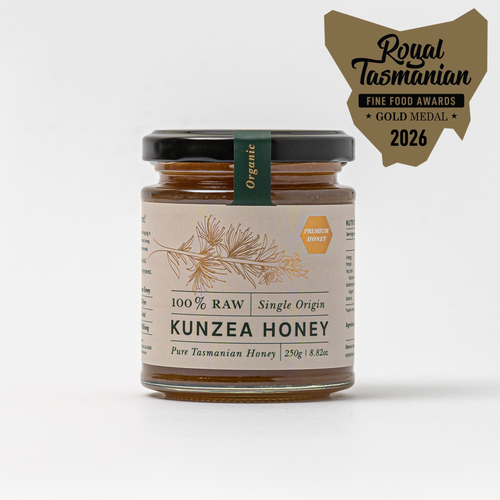
Kunzea ambigua is the same Tasmanian native shrub behind Kunzea oil, and it flowers in a dense cloud of small white blossom for a short window in spring. Bees working that flowering produce a honey that looks and tastes nothing like Leatherwood or Manuka: pale gold, thick and buttery, sweet and smooth with only a soft herbal note at the back rather than the medicinal punch people expect from a native honey. It is the honey to hand someone who says they do not like native honey.
It is also genuinely scarce. Because the flowering is brief and the plant grows in remote coastal and north-east country, yields run at roughly one drum of Kunzea for every five drums of more common native honeys, and it is harvested only once a year. Zea Gourmet Kunzea Honey (North-East) is one of the first commercially available honeys from this species, and when a season runs out there is no more until the next spring. If you want the longer background on the plant and the harvest, we covered it in Kunzea Honey: Australia's Best-Kept Natural Secret, and there is separate reading on Kunzea as an anti-inflammatory functional food.
Manuka: what a Tasmanian label actually means
This is where most of the confusion sits, so it is worth being precise. Manuka honey comes from Leptospermum scoparium, and that plant is native to both New Zealand and south-eastern Australia, Tasmania included. Current evidence suggests the genus originated in Australia and reached New Zealand by long-distance dispersal. Australia has more than 80 Leptospermum species, and testing has found high non-peroxide antibacterial activity in several of them, with methylglyoxal levels up to around 1,100 mg/kg recorded in L. polygalifolium honey.2
So Tasmanian Manuka is not an imitation of a New Zealand product. It is the same species growing where it has always grown. The number on the jar is what tells you about strength: MGO is a direct measurement of methylglyoxal in milligrams per kilogram, formed in the honey from dihydroxyacetone present in the nectar. Higher MGO means more measured antibacterial activity in the laboratory, and a stronger, more bitter flavour.
One practical note on price and availability. Tasmanian Manuka went through an oversupply from 2019-20 that cut prices and reduced the value of the Manuka crop by 62% in a single year,1 which is part of why Australian Manuka has become better value than it once was. We have a full explainer on the grading systems in The Ultimate Guide to Manuka Honey: MGO and UMF ratings explained. Our own Manuka Raw Honey MGO 100+ is harvested on Flinders Island.
Coastal Tea Tree, Prickly Box and the other natives worth hunting down
Coastal Tea Tree is Leptospermum laevigatum, a close relative of Manuka that grows on coastal dunes, cliffs and heath through Tasmania, Victoria and New South Wales.8 The honey carries a smoky, resinous, almost savoury character, and it is often sold as smoky tea tree honey for exactly that reason. It suits cheese and roast vegetables far better than it suits a cup of tea.
Prickly Box comes from Bursaria spinosa, a spiny native shrub that flowers through summer on the dry hills of southern Tasmania, particularly the Coal River Valley.9 It is the sleeper of the Tasmanian range: bright yellow, notably less sweet than most honeys, with nutty caramel, butterscotch and marzipan notes and very little aftertaste. It granulates quickly into a thick candied honey, which is a feature rather than a fault. Because it depends on dry country flowering, drought hits it hard and supply is genuinely unpredictable.
Blue Gum and other eucalypts give the malty, mildly medicinal honey most Australians think of as bush honey. Eucalypts flower irregularly, so a big Blue Gum year is an event.
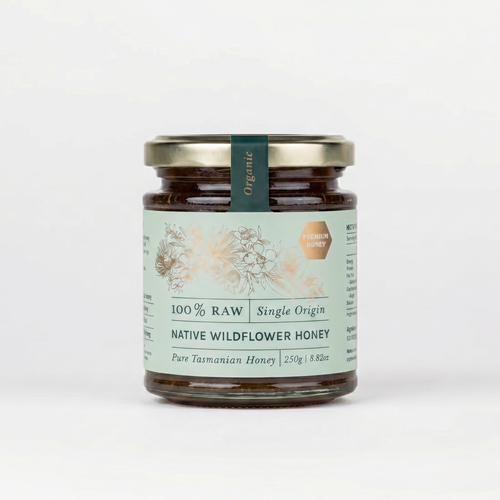
If choosing between single varietals feels like too much work, a native wildflower blend is the sensible entry point. Our Flinders Island Native Wildflower Honey is exactly that: bees foraging kunzea, coastal tea tree, manuka, blue gum and seasonal wildflowers across untouched island bush, which lands lighter and more floral than any of those flowers on its own.

Clover, Meadow, Blackberry and Fennel: the honeys from introduced plants
Not all Tasmanian honey is native, and there is nothing wrong with that. The open woodlands and pastures of the northern midlands produce clover, blackberry, thistle and mixed wildflower honeys, and these are the everyday jars. Clover in particular is a serious commercial crop: in 2020-21 it was the second most valuable Tasmanian variety after Leatherwood at $1.4 million.1
Clover is the pale, mild, clean-tasting honey that suits baking and children. Meadow or pasture honey is a multifloral from the same country, softer and more variable, and worth buying from a producer who tells you the season. Blackberry honey has a fruity, faintly tart edge and comes from thickets that are, ironically, a weed problem.
Fennel honey is the oddity and the one collectors chase. Foeniculum vulgare is a declared weed in Tasmania under the state's biosecurity legislation,4 and it grows in dense stands on roadsides and river flats. The honey is dark, savoury and carries a real aniseed note, which makes it useless on toast and excellent with pork, cheese or a salad dressing. The flowering window is short, so it appears and disappears.
How to choose, and how to buy well
- If you want the icon: Leatherwood. Intense, spicy, unmistakably Tasmanian. Try it before you commit to a big jar.
- If you want something rare and easy to eat: Kunzea. Buttery, sweet, no medicinal edge.
- If you want measured antibacterial activity: Manuka with an MGO number printed on the jar.
- If you want an everyday native honey: a native wildflower blend.
- If you want a cheeseboard honey: Coastal Tea Tree, Prickly Box or Fennel.
- If you want mild and familiar: Clover or Meadow.
Whichever you pick, three things on the label matter more than the variety. Look for raw, meaning cold extracted and not heat treated, because heating strips the enzymes and aroma compounds that make a varietal taste like itself. Look for single origin, so you know the honey is what it says rather than a blend of imported drums. And look for a named region, because "product of Australia" is not the same as a stated Tasmanian district. We go deeper into that in Raw honey vs regular honey.
Frequently asked questions
Is darker Tasmanian honey healthier than pale honey?
Colour tells you which flower the nectar came from, not how good the honey is. Darker honeys often carry more phenolic compounds and higher antioxidant activity, and Leatherwood measures well on antioxidant activity,6 but a pale Kunzea or Clover honey is not a lesser product. Choose on flavour and on how the honey was handled.
Why does my Prickly Box or Clover honey go solid?
That is crystallisation, and it is a sign the honey is raw and unprocessed rather than a fault. Some varietals granulate within weeks because of their natural sugar ratio. Stand the jar in warm water if you want it runny again, and avoid boiling water or a microwave.
Does Tasmanian honey expire?
Honey is one of the few foods that effectively does not spoil when it is stored sealed and dry. Flavour and aroma do fade over years, so eat your good varietals rather than saving them. More detail in Does honey expire or spoil?
Is Tasmanian Manuka as good as New Zealand Manuka?
It is the same species, Leptospermum scoparium, growing natively in both places, and Australian Leptospermum honeys have been shown to carry non-peroxide antibacterial activity that correlates with their methylglyoxal content.2 Compare MGO numbers, not countries.
Why is Kunzea honey more expensive than Leatherwood?
Volume. Leatherwood was 768 tonnes of an approximately 1,012 tonne crop in 2020-21.1 Kunzea comes from one short spring flowering with roughly a fifth of the yield of common native honeys, and there is no second harvest if it runs out.
Can I cook with these honeys?
Yes, though it is a waste of the delicate ones. Use Clover or Meadow for baking, save Leatherwood, Kunzea, Fennel and Prickly Box for raw uses where you can actually taste them. We have ideas in 7 delicious ways to use raw honey.
Tasmania is one of the few places left producing honey that tastes like a specific patch of country in a specific few weeks of the year. If you have only ever tried Leatherwood, the rest of the range is worth working through. You can see the full Zea Gourmet range of raw Tasmanian honeys, all cold extracted, single origin and packed the same season they are harvested.
About the Author
Hayden Brass, Founder & CEO of Zea
Hayden founded Zea in 2016 as a family market stall in Tasmania, built around Australian Kunzea. Zea has since grown into a multi-brand natural health company and Australia's only Certified B Corporation in natural pain relief, and the Zea Gourmet range of raw Tasmanian honeys grew out of the same relationships with growers and beekeepers on Flinders Island and in the state's north-east. Read more about Zea's story →
References
Sources open in a new tab so you do not lose your place.
- 1. Department of Natural Resources and Environment Tasmania. Tasmanian Beekeeping Survey 2021 Report. View source
- 2. Williams S, et al. The antibacterial activity of Australian Leptospermum honey correlates with methylglyoxal levels. PLOS ONE. View source
- 3. ABC News. Fragile leatherwood flowers after dry spell have Tasmanian beekeepers on edge. View source
- 4. Department of Natural Resources and Environment Tasmania. Declared weeds index: Fennel. View source
- 5. Australian National Botanic Gardens. Growing Native Plants: Eucryphia lucida. View source
- 6. Characterisation of Tasmanian leatherwood (Eucryphia lucida) honey according to geographical origin. Food Chemistry. View source
- 7. 4-Methoxymandelic acid: a leatherwood (Eucryphia lucida) honey marker for authentication. PMC. View source
- 8. Leptospermum laevigatum (coastal tea tree) species profile. View source
- 9. Bursaria spinosa (prickly box) species profile. View source

![Manuka Raw Honey [MGO 100+] - High Activity](http://www.zeaaustralia.us/cdn/shop/files/ZG-Manuka_100MGO_Honey-250g_Neutral-1x1_7f9245eb-295c-4905-a45c-d9dd0c8b17b3.jpg?v=1776732039&width=500)
![Manuka Raw Honey [MGO 200+] - High Activity](http://www.zeaaustralia.us/cdn/shop/files/ZG-RZG250MH-Manuka_Bioactive_Honey-250g_Neutral-1x1-26072021.jpg?v=1776732082&width=500)


